
What Restrooms Does a Film Set Actually Need?
Crew size and shoot length decide everything. A short commercial shoot with 15 people might get by with two standard porta potty rentals, but a feature with 60 crew plus talent needs something closer to a 4 stall restroom trailer so department heads aren't waiting in line between takes. OSHA 1926.51(c) sets the baseline for construction-style crews: one toilet for 20 workers or fewer, then a seat and urinal per 40 workers up to 200. Film sets aren't construction sites, but production companies in Aurora use that ratio as a floor, not a ceiling, because talent trailers and holding areas add foot traffic the ratio doesn't count.
Location matters too. A shoot on a residential street in Aurora has different placement limits than one on a closed lot. If cast needs privacy and climate control, a luxury restroom trailer with individual stalls beats a bank of porta john rentals lined up on the curb. For a modest crew and a single-day shoot, a deluxe flushable porta potty covers flushing and a sink without the footprint of a trailer. Multi-day shoots often add a handwashing station rental near catering, since 29 CFR 1910.141(d)(2) requires soap and towels or a drying device at wash stations, not sanitizer alone. Check how many porta potties do I need before you lock the order, especially if background extras are on the call sheet.
Where Should Restrooms Go on a Closed Set?
Placement on a film set is about sightlines as much as convenience. Units need to sit outside camera frame but close enough that a 10-minute company move doesn't turn into 20. A pad that's stable, firm and slip resistant matters here too, the same standard ADA Standards section 302.1 sets for accessible routes, because rolling grip carts and generator cable across gravel or mud slows a whole crew down. If the location sits within Aurora city limits, placement in the public right of way needs confirming with the city before delivery day; a residential street closure for exteriors is a different conversation than parking on a private studio lot.
Access counts as much as placement. A roll-off dumpster rental for set strike debris needs about 60 feet of straight clearance behind the truck, so plan the dumpster and the restroom trailer drop on the same side of base camp if the street is tight. Crews running a generator for lighting and a portable generator rental film package should route cable away from the restroom entrance path, both for trip hazards and because ADA Standards section 405.2 caps ramp slope at 1:12 for any trailer with a ramp. If your production needs temporary fence rental to hold back onlookers, place the fence line so it doesn't box in the restroom queue. For night shoots, pair restrooms with a light tower rental so the path stays lit without running a separate cord from base camp.
Does a Film Crew Need an ADA-Compliant Unit?
Yes, if your set has any single-user units clustered together, at least one has to be accessible, and that's true at even a small crew size. ADA Standards section 213.2 requires 5 percent of a cluster to be accessible units, never fewer than one, so a two-unit order on a tight budget still needs an ADA accessible porta potty in the mix. That unit needs a 60 inch turning circle inside per ADA Standards section 304.3.1, and the door opening has to clear 32 inches per ADA Standards section 404.2.3, wider than a standard unit's frame allows.
Productions in Aurora with cast members or crew using mobility devices should plan this into the initial quote rather than swap units on shoot day. A portable restroom rental order with mixed accessible and standard units costs about the same as an all-standard order at the same headcount, since ADA units sit in a similar day-rate band. Full details on route width and reach ranges are on ADA restroom requirements if your locations department needs it for the permit packet.
| unit | day | week |
|---|---|---|
| standard | $100 - $350 | $130 - $500 |
| ada | $200 - $400 | $200 - $400 |
| deluxe | $85 - $1,200 | $150 - $290 |
Delivery adds a separate line, typically $100 to $500 for a single day drop depending on distance and access. Multi-week productions save by locking a weekly rate instead of renewing day rentals; see porta potty rental cost for how the math shifts at longer terms.
How far in advance should I book restrooms for a shoot?
Book as soon as your location is locked, ideally two to three weeks out for anything over a two-day shoot. Trailers and ADA units have fewer units in rotation than standard portables, so short notice limits your options. Check emergency porta potty rental if a location changes last minute.
Can restrooms run without hookup to city water?
Yes. Standard units carry a 60 to 70 gallon holding tank and need no water or sewer hookup at all. Restroom trailers with sinks need a fresh water fill and periodic pump-out, which your provider schedules around shoot days.
Do film sets need handwashing stations separate from the restrooms?
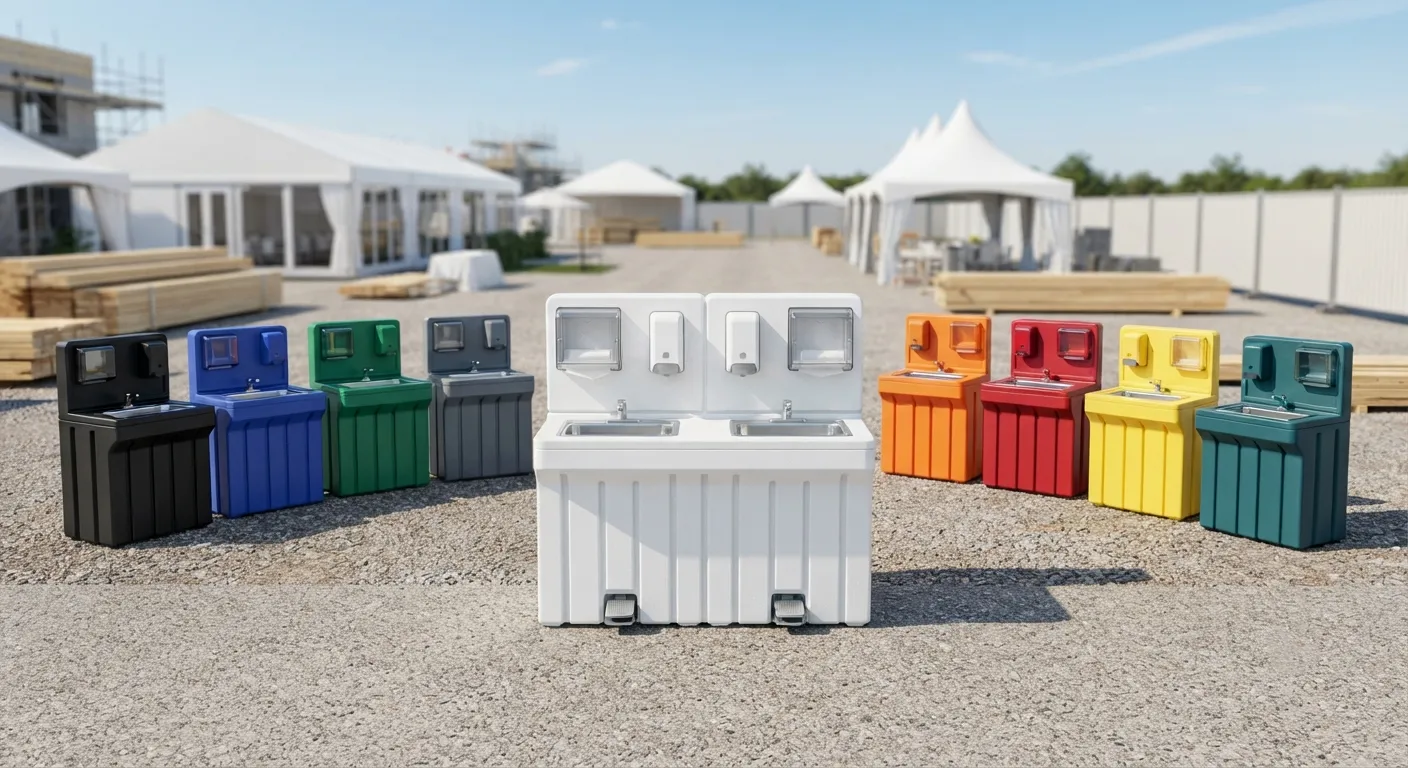
Often yes, especially near catering or makeup stations away from the restroom cluster. A dedicated portable sink rental keeps handwashing compliant with 29 CFR 1910.141(d)(2) without crew walking back to base camp.
What if the shoot location is outside Aurora?
Aurora Porta Pros services nearby towns too. Aetna Estates sits 4.7 miles northeast and Watkins is 13.3 miles east; check service areas for full coverage and drive-time notes.
How many restrooms does a 50-person crew need?
Using the OSHA 1926.51(c) ratio as a guide, a 50-person crew clears the 20-and-under tier and moves into the 20-to-40 tier, meaning at least one toilet and one urinal, plus more units for comfort during long shoot days. Most productions add extra capacity beyond the minimum.
Next step
Get a delivery date
Tell us the address, the dates and the headcount. We size the order and confirm the route.